
Most recommended · The Complete Solar System
The Complete Solar System Tour: Every World, Moon, Comet and Probe
Our longest and most recommended flight covers everything from the Sun to the edge of what we know: all eight planets, five dwarf planets, fourteen major moons, an asteroid and a real comet, the Kuiper Belt and the spacecraft humanity has sent out, with real photos and a source for every number.
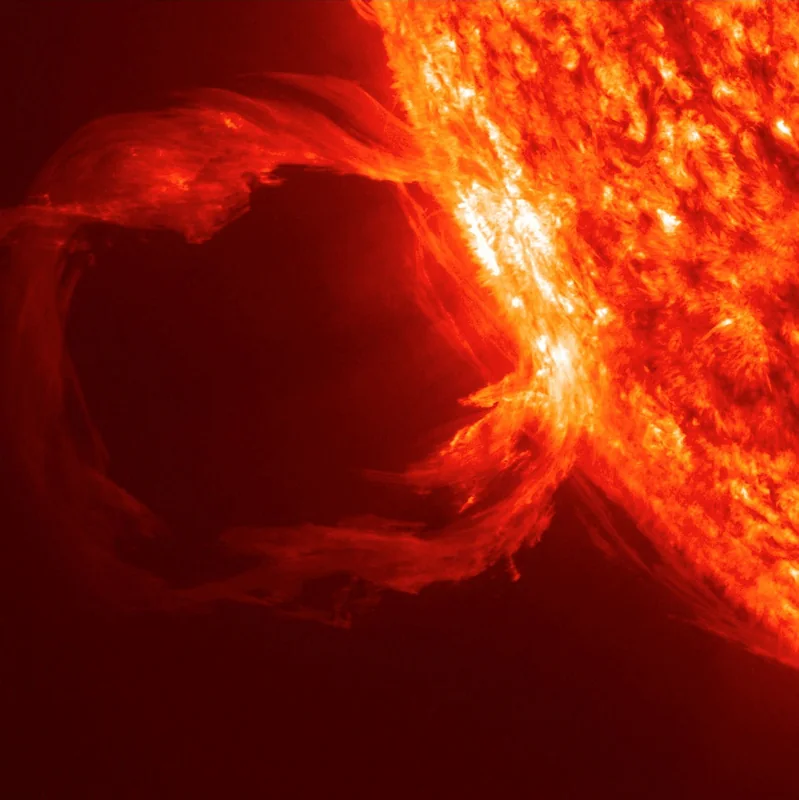
The Grand Tour shows every planet. The Complete Solar System shows everything else too: the worlds between and beyond the planets, the small bodies that tell how the Solar System formed, and the machines we have built to explore it, each one clearly separated from the natural objects.
We hold it to the same standard as every LIFTONAUT flight: real positions for the day you launch, gradual approaches, full orbits and real photos with their credits. Where nobody has ever taken a close-up photo, the screen says so.
What is inside the Complete Solar System tour
- The Sun up close, with sunspots, prominences and the corona.
- All eight planets, each with a full orbit, explained as two families: the rocky inner planets and the giants.
- Five dwarf planets: Ceres, Pluto, Eris, Haumea and Makemake.
- Fourteen major moons, with short flybys: our Moon, Phobos, Deimos, Io, Europa, Ganymede, Callisto, Titan, Enceladus, Mimas, Miranda, Titania, Triton and Charon.
- Asteroids and a real comet: the main belt, a close visit to the asteroid Vesta with real images from NASA’s Dawn mission, the Trojans of Jupiter and comet 67P.
- The edge: the Kuiper Belt, the hypothetical Oort Cloud and the spacecraft, from Hubble and Webb to the Voyagers.
The flight is divided into 20 chapters you can jump between, and it ends with a richer educational summary, a special certificate and the “Solar System Explorer” badge.
The Sun up close
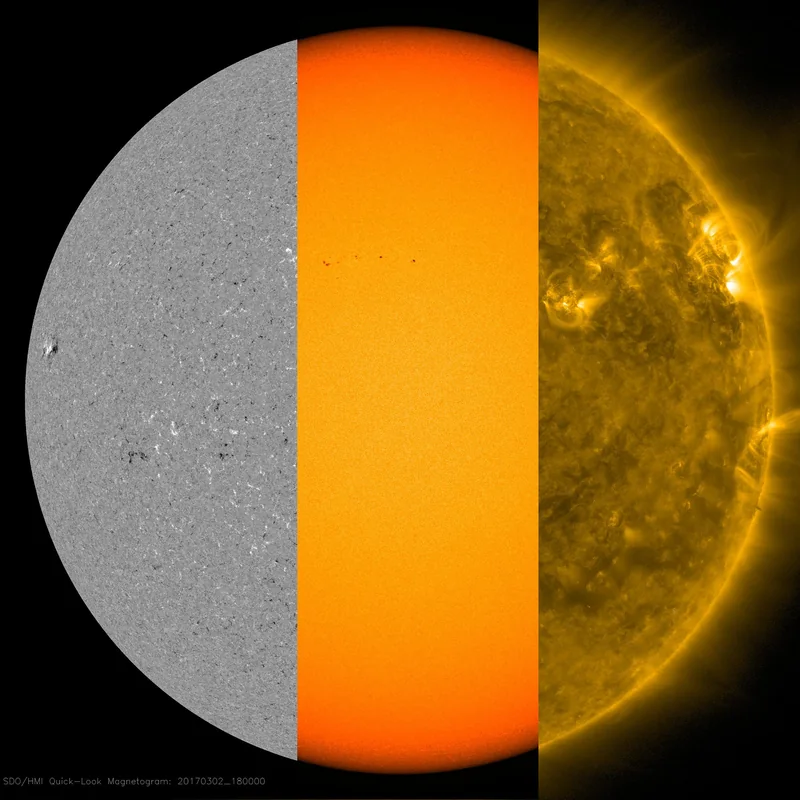
The Sun holds 99.8% of all the mass in the Solar System, and about 1.3 million Earths would fit inside it. Its visible surface, the photosphere, is about 5,500 °C, while the corona, its thin outer atmosphere, reaches up to about 2 million °C. Why the corona is so much hotter than the surface is one of the questions Parker Solar Probe was built to study.
You look at it through the window's protective filter, which the crew explains, and the screen marks NASA's Parker Solar Probe at its real position on its orbit. On its closest passes, Parker flies about 6.1 million km above the solar surface at almost 700,000 km/h; our ship keeps a realistic distance.
Eight planets, five dwarf planets
The International Astronomical Union recognizes five dwarf planets: worlds that orbit the Sun and are nearly round, but have not cleared their orbits of other bodies.
Ceres, Pluto and Charon: real photos
Ceres, about 950 km across, is the largest object in the asteroid belt and the only dwarf planet in the inner Solar System; NASA's Dawn mission orbited it from 2015. Pluto and its large moon Charon were photographed by New Horizons on July 14, 2015, and that is what you see.
Eris, Haumea and Makemake: artistic reconstructions, clearly marked
No spacecraft has ever visited these three, and even the Hubble telescope sees them only as points of light. Their surfaces on screen are therefore reconstructions, labeled as such. What we do know is real: Eris is about the size of Pluto and, right now, almost three times farther from the Sun; Haumea is oval, spins once every four hours and was the first Kuiper Belt object found to have rings.
Arrokoth and the Kuiper Belt
Beyond Neptune, from about 30 to 50 astronomical units, lies the Kuiper Belt, likely home to hundreds of thousands of icy bodies larger than 100 km. New Horizons flew past one of them, Arrokoth, on January 1, 2019: two joined lobes about 35 km long, the most distant object ever explored up close.
Moons, asteroids and a real comet
The moons are some of the strangest places in the tour: Io and its volcanoes, the hidden oceans of Europa and Enceladus, Titan's methane seas, Mimas and its 130 km Herschel crater, the patchwork cliffs of Miranda.
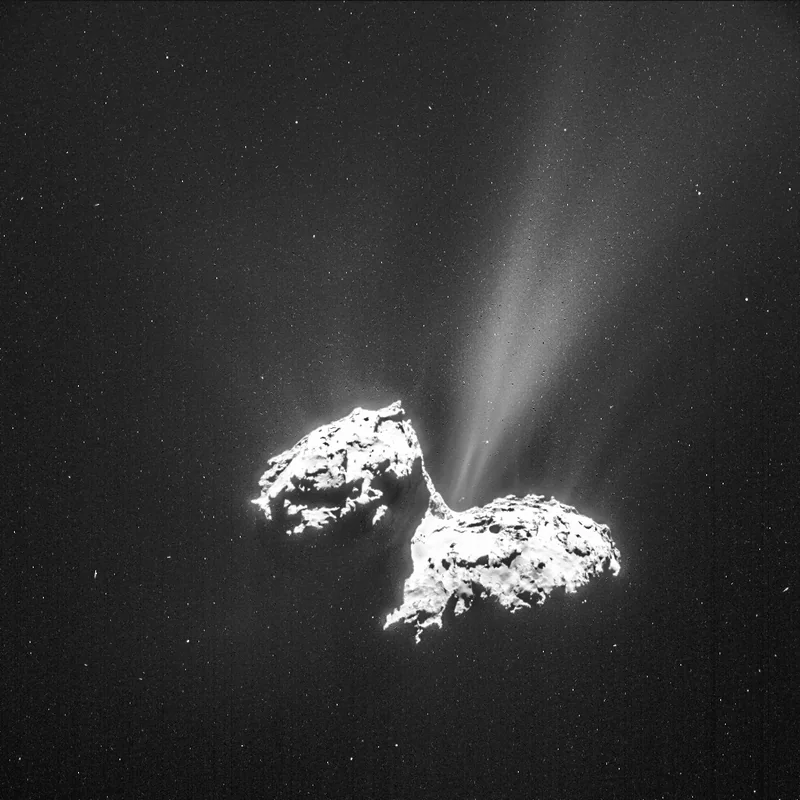
In the belt you visit the asteroid Vesta, photographed by NASA’s Dawn, and the guide explains the Trojans, two swarms of asteroids that share Jupiter's orbit. Then comes comet 67P, which ESA's Rosetta orbited from 2014 to 2016: a nucleus about 4 km long. Near the Sun a comet grows a coma and two tails, one of dust and one of gas, and both point away from the Sun, not behind the comet.
The Kuiper Belt, the Oort Cloud (a hypothesis) and spacecraft
A hypothesis, not a photoNo object has ever been observed inside the Oort Cloud. Astronomers think it exists because of the comets that fall from it, and NASA places its inner edge somewhere between 2,000 and 5,000 AU from the Sun and its outer edge between 10,000 and 100,000 AU. On screen it is a model, and it is labeled as one.
The human-made objects are shown separately from the natural ones, at their real positions for the day of the flight: the International Space Station, the Hubble telescope, Webb at the L2 point 1.5 million km from Earth, communication satellites, Juno at Jupiter, New Horizons, and the Voyagers, both in interstellar space, with Voyager 1 now more than 160 astronomical units from us.
Who it is for: curious learners, families and schools
It is the flight for people who want to understand the whole system, not just see it. Self-learners will find a structured path on our learn astronomy online page. Families and classes can take a private rocket for up to 20 people, 30% below the ticket price per seat; teachers can read our virtual field trip guide. For a shorter overview, the Grand Tour covers every planet in about 26 minutes.
Complete Solar System questions
What is the most complete virtual tour of the Solar System?
The LIFTONAUT Complete Solar System tour covers the Sun, all eight planets, the five recognized dwarf planets, fourteen major moons, an asteroid, comet 67P, the Kuiper Belt, a labeled model of the Oort Cloud and the main spacecraft, in a single guided, simulated flight.
Which dwarf planets are in the Solar System?
The International Astronomical Union recognizes five: Ceres, Pluto, Haumea, Makemake and Eris. Ceres is in the asteroid belt; the other four are in the Kuiper Belt or beyond.
Is the Oort Cloud real?
It is a well-supported hypothesis, not an observed place: no object has been seen inside it. NASA places it between about 2,000 and 100,000 AU from the Sun, which is why the tour shows it as a labeled model.
How long is the tour?
About 67 minutes at normal speed, from the GO/NO-GO poll to landing: the longest LIFTONAUT flight, much longer than the Grand Tour (26 minutes), divided into 20 chapters you can jump between.
Is it suitable for school lessons?
Yes. Every number has a source, reconstructions are labeled, and a class of up to 20 can fly together in a private rocket, with the teacher in Mission Control.
Sources
The numbers on this page come from these official sources.
- NASA Science · Sun facts
- NASA Science · Parker Solar Probe
- NASA Science · Parker Solar Probe Makes History With Closest Pass to Sun (2024)
- NASA Science · Dwarf planets
- NASA Science · Ceres
- NASA Science · Eris
- NASA Science · Haumea
- NASA Science · Arrokoth (2014 MU69)
- NASA Science · Kuiper Belt facts
- NASA Science · Oort Cloud facts
- NASA Science · Comet facts
- ESA · Rosetta factsheet
- NASA Science · Vesta
- NASA Science · Webb mission
- NASA Science · Voyager 1