
Earth orbit
Earth From Orbit: See the Planet and Pass the Space Station
Four hundred kilometers up, Earth fills the window: blue oceans, white cloud fields, the thin glowing line of the atmosphere and, on the night side, cities drawn in light. The LIFTONAUT Earth Orbit tour flies one full lap around the planet, with an orbital sunrise and sunset and a close pass by the International Space Station.

Low Earth orbit is where the astronauts on the space station live and work, and where the view is most spectacular: close enough to see coastlines and storms, high enough to see the curve of the planet.
This page explains what Earth really looks like from there, what the station is, and what to expect from our simulated orbit, including what it is not.
What Earth looks like from orbit
The first surprise is how thin the atmosphere looks: a narrow blue band at the edge of the planet, because almost all of the air lies below 30 km. The second is the speed. At about 400 km a spacecraft covers 7.7 kilometers every second, so coastlines slide past like a map on a conveyor belt.
On the LIFTONAUT route you leave Florida behind over the Atlantic, reach the coast of West Africa, cross the equator over Gabon and the Congo rainforest, pass the Indian Ocean and Madagascar, fly over Australia at night and return across the Pacific and the Gulf of Mexico.
Sunrise and sunset roughly every 90 minutes
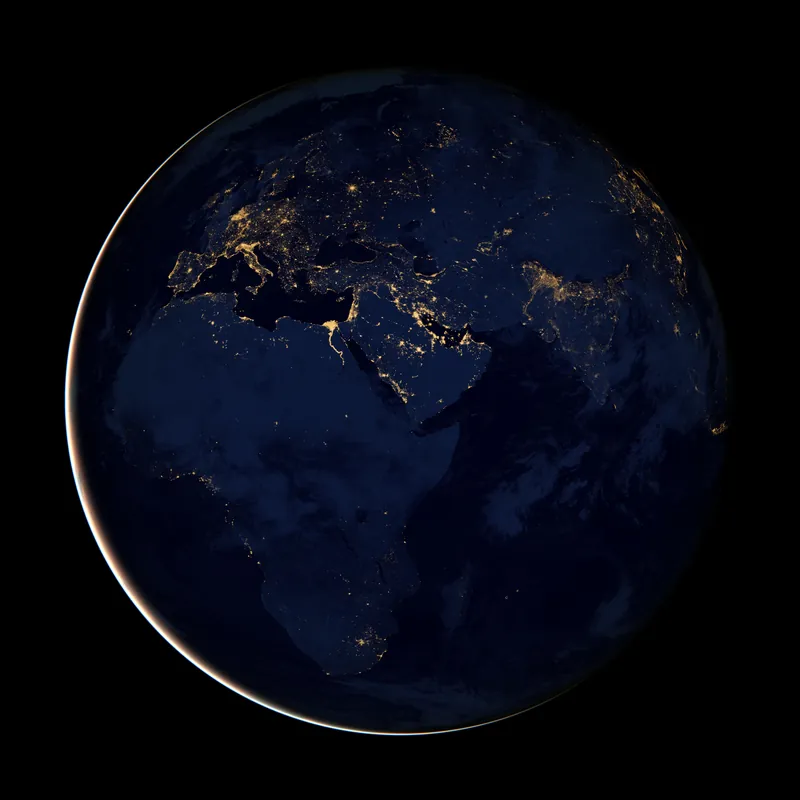
At this height one lap takes about 92 minutes, so a crew in orbit sees around 16 sunrises and 16 sunsets every 24 hours. Each one is fast: the terminator, the line between day and night, sweeps under the ship in seconds, and the horizon flashes through orange, red and blue.
On the night side, a faint green band hangs above the horizon. It is airglow, light given off by the upper atmosphere about 100 km up. Lightning flickers inside the storms below, and the stars stay steady: without air in the way, they do not twinkle.
Passing the International Space Station
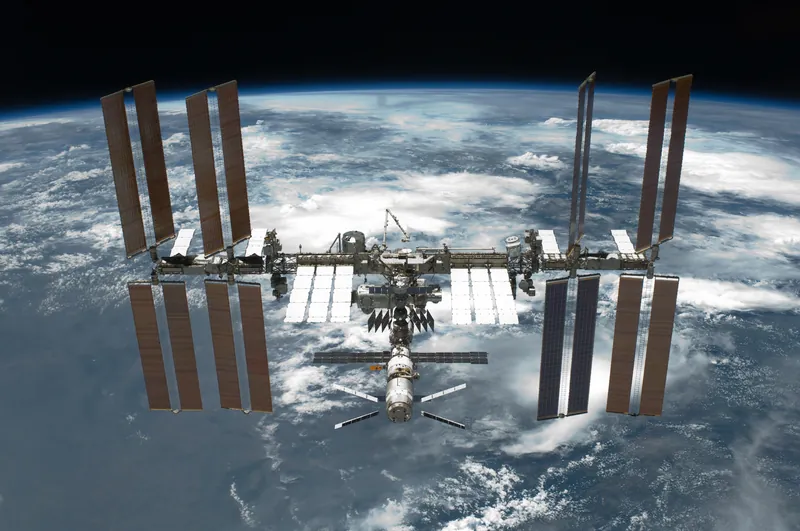
People have lived on board the station without a break since November 2000. In the simulation it is placed on its real orbit, inclined 51.6° to the equator, and the ship passes it at a distance of about 17 km, close enough to make out its solar arrays.
How big is the station?
About 109 meters from end to end, one yard shy of an American football field including the end zones, with a mass of about 420 tonnes and a pressurized volume of about 1,000 cubic meters.
How fast does it travel?
About five miles, or eight kilometers, every second: roughly 28,000 km/h. It makes 16 orbits of Earth every day.
Where to see the real station from your city
The real station is easy to spot with the naked eye. NASA's Spot the Station service lists passes for your location: it looks like a very bright star moving steadily across the sky, without blinking lights, and all sightings happen within a few hours of sunrise or sunset.
A flyby, not a tour inside: what to expect
To be clear: the Earth Orbit tour flies past the space station; it does not dock with it or take you inside. Our ship stays on its own orbit, and the station crosses your view. Everything you see outside follows real data; the ship itself is LIFTONAUT's own design.
The Earth Orbit tour: 10 minutes, from €0.99
The tour lasts about 10 minutes: the GO/NO-GO poll, the launch, one full orbit with sunrise and sunset, the station pass, the deorbit burn, re-entry through the plasma and a landing on the same pad. It is the cheapest LIFTONAUT flight, and the best way to understand what orbit really means.
For the launch itself, read about our rocket launch simulator; for what crews see and hear, what astronauts see and hear. The Moon tour is the next step outward.
Orbit questions
What does Earth look like from space?
From low orbit you see a curved horizon, a thin blue line of atmosphere, white cloud systems and blue oceans by day, and cities and lightning by night. The view changes fast, because a spacecraft circles the planet in about 90 minutes.
How fast does the ISS travel?
About eight kilometers per second, roughly 28,000 km/h (17,500 mph). It makes 16 orbits of Earth every 24 hours.
Can you take a virtual tour of the ISS?
LIFTONAUT flies past the station on its real orbit, about 17 km away, but does not take you inside. For the interior, NASA publishes photos and videos made by the crews.
How long does it take to orbit the Earth?
About 90 minutes at the height of the space station; at 400 km the period is about 92 minutes. Higher orbits take longer.
Can I see the space station from Earth?
Yes, with the naked eye. It looks like a bright star moving steadily across the sky, without flashing lights, a few hours before or after sunrise or sunset. NASA's Spot the Station service tells you when it passes over your city.
Sources
The numbers on this page come from these official sources.