
Destination · The whole Solar System
Solar System Tour: The Grand Tour Past Every Planet
The Grand Tour is the LIFTONAUT flight that visits everything: the Moon, every planet from Mercury to Neptune, the major moons, the asteroid belt and Pluto, in about 26 minutes, with a guide and with every world exactly where it is on the day you launch.

No real spacecraft has ever made this trip in one go. The Voyager probes flew past the giant planets over twelve years, and New Horizons needed more than nine years to reach Pluto. The Grand Tour compresses the time and keeps everything else real: the distances, the positions, the light of the Sun at each stop.
Here is the route, what you learn at each stop, and how to choose between the Grand Tour and the Complete Solar System.
The Grand Tour at a glance: stops, order, minutes
The route visits the worlds in this order, first toward the Sun, then outward:
- The Moon, on the way out of Earth orbit.
- Venus and Mercury, the inner rocky planets, closer to the Sun.
- Mars, then the crossing of the asteroid belt.
- Jupiter, Saturn, Uranus and Neptune, the giants.
- Pluto, the farthest point, before the ship turns for home.
At each planet the ship approaches gradually and flies a full orbit while the guide explains what you see. The flight ends with re-entry and a landing on the same launch pad, about 26 minutes after the GO/NO-GO poll.
Inner planets: Moon, Venus, Mercury
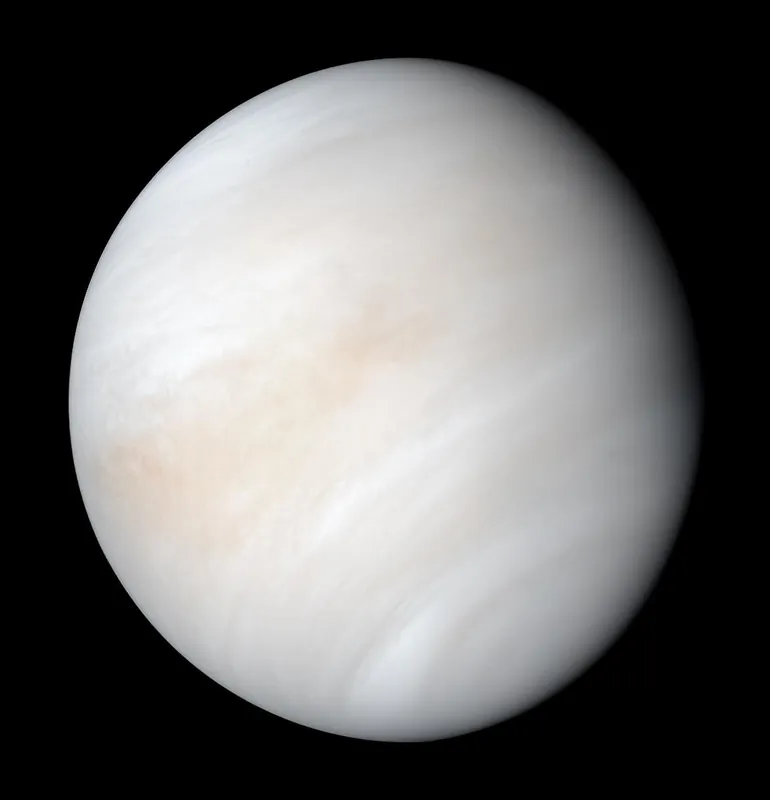
After the Moon, the ship heads sunward. No planet comes closer to Earth than Venus, sometimes only 38 million km away, and none is hotter: about 464 °C at the surface, hot enough to melt lead, because its thick carbon dioxide air traps the heat. The pressure there is 92 times Earth's, and no probe has survived on the surface for more than about two hours. Venus also spins backwards, so the Sun rises in the west.
Mercury, the smallest planet, circles the Sun in just 88 days. Days reach 430 °C and nights −180 °C, and yet scientists think its permanently shadowed polar craters hold water ice. From there the Sun looks two to three times bigger than from home.
Mars and the asteroid belt
Mars is red because the iron minerals in its dust have rusted. You pass Olympus Mons, the largest known volcano in the Solar System, and the guide tells you about Perseverance, which landed in Jezero Crater in 2021. Then comes the asteroid belt, estimated to hold more than a million asteroids larger than 1 km. It is nothing like the movies: on average neighboring asteroids are more than three times the Earth–Moon distance apart. More on our trip to Mars page.
The giants: Jupiter, Saturn, Uranus, Neptune
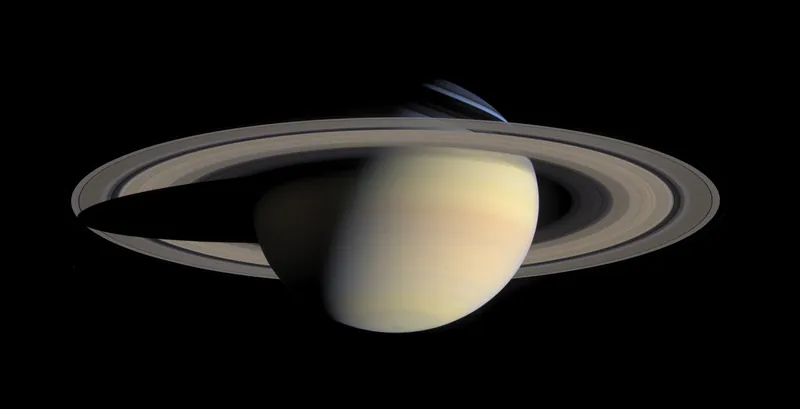
Jupiter could hold more than 1,300 Earths, and its Great Red Spot is a storm bigger than our planet. Saturn's rings reach 282,000 km from the planet, yet the main rings are typically only about 10 meters thick. Uranus spins on its side, and Neptune has winds of up to 580 m/s. Between them these four planets have hundreds of known moons, from volcanic Io to Titan, the only moon with a thick atmosphere. More on our Saturn and Jupiter page.
Pluto and the edge of the tour
Pluto is smaller than our Moon, only 2,376 km across, and sunlight takes about five and a half hours to get there. Its giant bright heart, Tombaugh Regio, is named after Clyde Tombaugh, who discovered Pluto in 1930. New Horizons flew past on July 14, 2015 and showed it for the first time as a world, with mountains of water ice and layers of haze. Since 2006 it has been classified as a dwarf planet.
Pluto is where the Grand Tour turns back. Beyond it lies the Kuiper Belt, a vast region of icy bodies, and much farther the Voyager probes, now in interstellar space.
Grand Tour or Complete Solar System: which one fits?
The Grand Tour: 26 minutes, €4.99
The best overview: every planet, the main moons and Pluto in one evening, with the essential facts at each stop. It is the flight we recommend after the free trial flight.
The Complete Solar System: dwarf planets, comets, probes
Our longest flight goes deeper: the Sun up close, five dwarf planets, more moons, a visit to a real asteroid and a real comet, the Kuiper Belt, a clearly labeled model of the hypothetical Oort Cloud, and spacecraft such as Hubble, Webb and the Voyagers. See the Complete Solar System.
Tour questions
Is there a virtual tour of the Solar System?
Yes. The LIFTONAUT Grand Tour is a guided, simulated flight past every planet, the Moon, the major moons, the asteroid belt and Pluto, in about 26 minutes, with the planets in their real positions for the launch date.
How long would it take to travel the whole Solar System?
Years to decades. New Horizons, launched faster than any spacecraft before it, needed more than nine years to reach Pluto, and Voyager 2 took twelve years to reach Neptune. NASA estimates that Voyager 1 will need about 300 years just to reach the inner edge of the hypothetical Oort Cloud, and possibly 30,000 years to pass beyond it.
Which planets does the Grand Tour visit, and in what order?
After the Moon: Venus, Mercury, Mars, Jupiter, Saturn, Uranus and Neptune, then the dwarf planet Pluto, before returning to Earth.
Are the distances in the tour to scale?
Yes. In the 3D view the planets are at their real distances and sizes, and only the time is compressed. On the 2D map, distances are drawn on a logarithmic scale so the whole Solar System fits on one screen.
Which tour is best for a first flight?
Start with the free trial flight to the Moon. For a complete first trip, the Grand Tour at €4.99 shows every planet in one flight; for a shorter one, choose the Moon or Mars.
Sources
The numbers on this page come from these official sources.
- NASA Science · Our Solar System
- NASA NSSDCA · Planetary Fact Sheets
- NASA/JPL · Approximate Positions of the Planets
- NASA Science · Venus facts
- NASA Science · Mercury facts
- NASA Science · Pluto facts
- NASA Science · New Horizons
- NASA Science · Voyager 2
- NASA Science · Voyager frequently asked questions (the Oort Cloud)