
Space tourism
Space Tourism, Without Leaving the Ground: The Virtual Alternative
Space tourism is real, but it is still rare: a handful of private flights a year, prices from hundreds of thousands to tens of millions of dollars, and months of preparation. Here is what a real trip involves today, what it costs, and what a virtual flight can honestly offer instead.

This page separates two things that are easy to mix up. Real space tourism means private citizens leaving Earth on a rocket. LIFTONAUT is something else: a simulated flight you watch from a passenger seat on your own screen, built on real data. Nobody leaves the ground, and we say so clearly.
If you are curious about the real thing, start with the facts below. If you want the view today, the virtual version is a few clicks away.
What real space tourism is today
Suborbital flights
A suborbital flight climbs to the edge of space and falls straight back, without going into orbit. Passengers get a few minutes of weightlessness and a view of Earth's curve against a black sky, and the whole trip lasts well under two hours.
Orbital flights
An orbital trip needs far more energy, about 28,000 km/h of sideways speed, and lasts days or weeks. NASA now offers the International Space Station as a destination for private astronaut missions: the first, Axiom Mission 1, lifted off in April 2022 for a 17-day mission, and later missions have lasted from about one to three weeks.
Why they remain rare
Rockets are expensive, seats are few, and each flight carries real risk. In the United States, operators must inform every passenger of the risks and tell them that the government has not certified the vehicle as safe for carrying crew or passengers.
What a real trip costs and what you get
Virgin Galactic, for example, sold its 2026 tranche of suborbital seats at $750,000 each, and expects its first new ship to enter commercial service in February 2027. Orbital seats have no public price list; for the first all-private crew to the space station, in 2022, each seat was reported at about $55 million.
| Suborbital | Orbital | |
|---|---|---|
| Price | $750,000 (2026) | about $55 million (reported, 2022) |
| Time in space | A few minutes | Days to weeks |
| Preparation | Training and medical checks | Months of training |
| What you see | Earth's curve, a black sky | Sunrises every 90 minutes, Earth below |
For that money you get something no simulation can give: the real g-forces, real weightlessness and the knowledge that you were there.
What a virtual trip can and cannot give you
A simulation cannot press you into your seat or make you float. It also cannot make you an astronaut, and LIFTONAUT never claims to. What it can give you is everything else that makes a mission fascinating, and some things no tourist flight offers:
- The whole mission: the GO/NO-GO poll, the launch, staging, orbit, re-entry and landing.
- Destinations no tourist reaches: the Moon up close, Mars, Saturn's rings and Pluto.
- Real data and real photos, with a source for every number.
- A price for everyone: tours from €0.99, and a free trial flight.
Which views are the same: Earth, the Moon, Mars
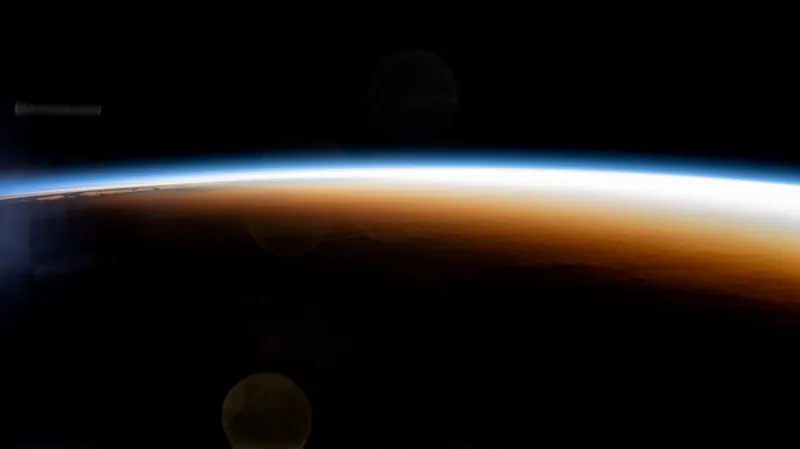
Some of what you see in the simulation is what real travelers see. The thin blue line of the atmosphere, orbital sunrise, city lights at night and the black daytime sky follow the same physics. Beyond orbit, the simulation shows places tourists cannot go: the Moon, which only the Apollo astronauts and the Artemis II crew have flown around, and Mars, which so far only robots have visited.
Try the virtual version: from orbit to the Grand Tour
Start with the free trial flight: liftoff, staging, orbit and the trip to the Moon. The Earth Orbit tour, at €0.99, is the closest thing to a tourist's orbital flight, with a pass by the space station. To go where tourists cannot, take the trip to Mars or the Grand Tour, at €4.99, past every planet. Tickets work like a ticket to space, with a boarding pass and a seat of your choice.
Space tourism questions
How much does a trip to space cost?
A real suborbital seat costs hundreds of thousands of dollars ($750,000 in one operator's 2026 price), and orbital trips cost tens of millions; about $55 million per seat was reported in 2022. A simulated LIFTONAUT flight costs from €0.99.
Who sells tickets for space tourism?
A few private companies. Some sell short suborbital flights; others, such as Axiom Space, organize orbital missions to the International Space Station in partnership with NASA. Prices are high and seats are limited.
Is space tourism safe?
Every spaceflight carries real risk. In the United States, operators must inform each passenger in writing of the risks, tell them that the government has not certified the vehicle as safe for carrying crew or passengers, and train them for emergencies.
Can an ordinary person go to space?
Yes, with enough money, good health and training: private citizens have flown both suborbital and orbital missions. For most people, though, the cost puts it out of reach, which is why we built a virtual alternative.
Is there a virtual alternative to space tourism?
Yes. LIFTONAUT is a simulated spaceflight in the browser: a seat in a ten-seat cabin, a realistic launch and orbit, and tours to the Moon, Mars and the planets, built on real data. It does not replace the real experience, and it does not pretend to.
Sources
The numbers on this page come from these official sources.
- NASA · Private Astronaut Missions
- Virgin Galactic · Second Quarter 2026 results (seat price, service date)
- CBS News · The people paying a reported $55 million for the first private space station mission (2022)
- U.S. Code of Federal Regulations · 14 CFR 460.45 (informing passengers of risk)
- NASA · Earth's Atmosphere: A Multi-layered Cake (the Kármán line)
- NASA · Space Station Facts and Figures