
Destination · The Moon
Travel to the Moon: A Simulated Flight Past the Apollo Sites
The Apollo crews needed about three days to reach the Moon. The LIFTONAUT Moon tour gets you there in a flight of about 10 minutes: launch, the departure burn, and a flyby about 1,000 km above the sunlit side, with the six Apollo landing sites marked at their real coordinates.
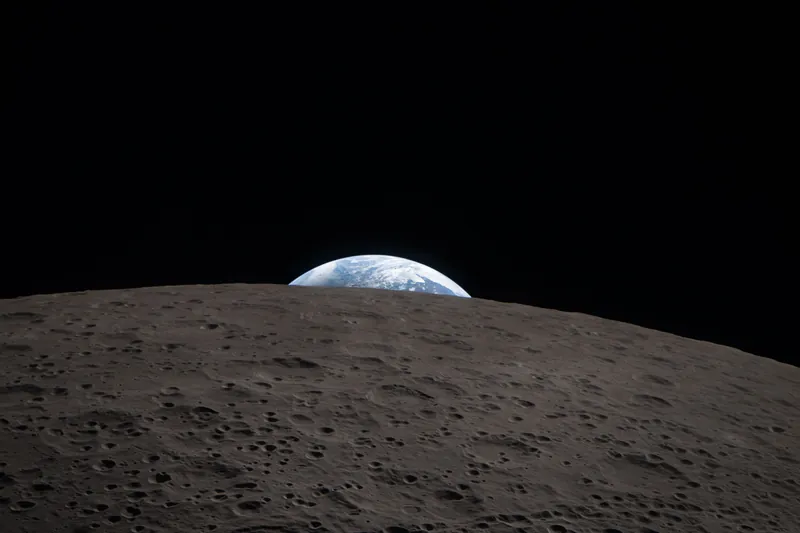
The Moon is the only other world people have walked on. Twelve astronauts did it between 1969 and 1972, on six Apollo missions, and their footprints are still there, because the Moon has no wind or rain to erase them.
Here is the real journey, the numbers behind it, and what you will see on our simulated flyby.
The road to the Moon: distance and travel time
On average the Moon is about 384,400 km from Earth (238,900 miles); its distance varies from about 363,300 km at the closest point of its orbit to 405,500 km at the farthest. That gap is wide enough to line up about 30 Earth-sized planets, yet light covers it in just 1.3 seconds.
- average distance from Earth
- 384,400 km
- the fastest Apollo trip, Apollo 8
- just under 3 days
- for light, or a radio call, to make the trip
- 1.3 seconds
The Apollo missions took about three days to get there. Apollo 8, the fastest, needed just under three days to go from Earth orbit to lunar orbit. Modern missions that want to save fuel can take weeks or even months on slower, looping routes. The Moon is also slowly drifting away from us, by about 3.8 cm a year.
The flyby: about 1,000 km above the sunlit side
After launch and a short time in Earth orbit, the ship fires its engines and heads out. The Moon grows in the window for long minutes before the approach: the guide explains what it is made of while the ship lines up for the flyby.
Then you pass about 1,000 km above the side lit by the Sun, close enough to see crater rims, mountain ranges and the dark plains, with Earth hanging in the black sky behind. The Moon is where it really is on the day you fly, and so is the line between lunar day and night.
Key numbers · The Moon
- Diameter
- 3,475 km
- Surface gravity
- 1.62 m/s² · 16% of Earth’s
- Length of day
- 29.5 days
- One orbit around Earth
- 27.3 days
- Mean temperature
- −20 °C (−173 °C … 127 °C)
- Average distance from Earth
- 384,400 km
The six Apollo landing sites, marked on the surface
Apollo 11 and the first landing
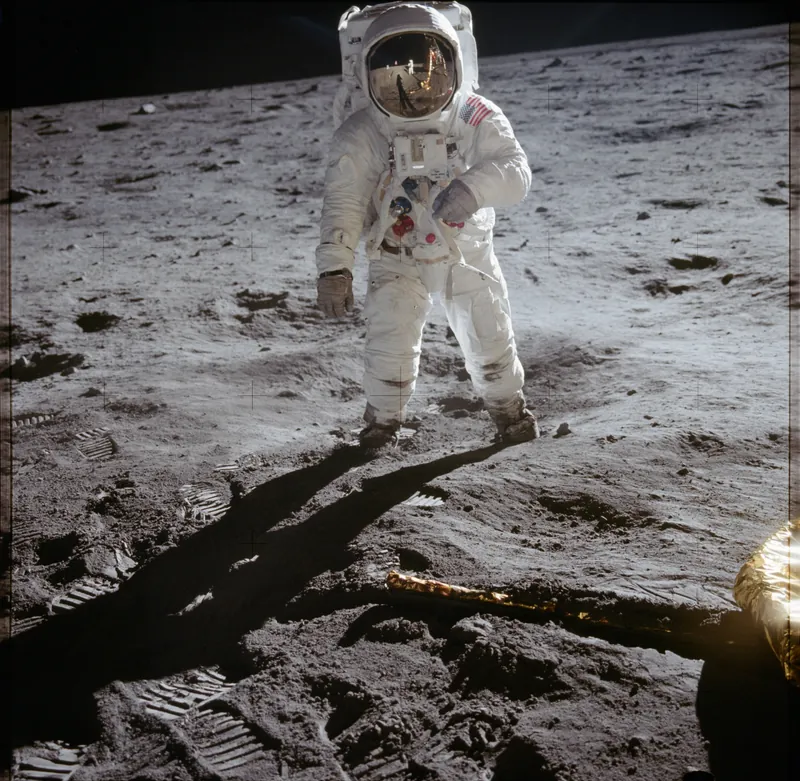
On July 20, 1969, the lunar module Eagle set down in the Sea of Tranquility, and Neil Armstrong and Buzz Aldrin walked on the Moon. Their landing site is the first marker you pass.
The other five sites
| Mission | Landing site | Year |
|---|---|---|
| Apollo 11 | Sea of Tranquility | 1969 |
| Apollo 12 | Ocean of Storms | 1969 |
| Apollo 14 | Fra Mauro highlands | 1971 |
| Apollo 15 | Hadley–Apennine | 1971 |
| Apollo 16 | Descartes highlands | 1972 |
| Apollo 17 | Taurus–Littrow valley | 1972 |
Real coordinates for the markers
Each marker sits at the official latitude and longitude of the lunar module landing site published by NASA, so it appears exactly where it should on the surface below. The modules themselves are far too small to see from 1,000 km; NASA's Lunar Reconnaissance Orbiter, flying much lower, has photographed the descent stages and the astronauts' tracks.
Craters, maria and light: what to look for
- Craters of every size, some billions of years old. With no air, no water and no weather, almost nothing wears them away.
- The maria, the dark plains you can see from Earth with the naked eye, are ancient lava flows. Apollo 11 landed on one of them.
- The light. Near the line between day and night, long shadows make every crater rim stand out. In full sun the surface reaches about 127 °C; in darkness it drops to about −173 °C.
One more thing the guide will tell you: the far side of the Moon is not dark. It gets as much sunlight as the near side; we simply never see it from Earth, because the Moon turns once on its axis for every orbit.
Tour details: duration, price, seats
The Moon tour lasts about 10 minutes, from the GO/NO-GO poll to touchdown on the same launch pad, and costs €1.99 per seat. Rockets carry ten passengers and leave every ten minutes. The Moon is also the first stop of the Mars tour and the Grand Tour; the free trial flight heads for it and ends as it fills the window.
Moon questions
How long does it take to travel to the Moon?
About three days with the direct trajectories of the Apollo missions; Apollo 8 took just under three days from Earth orbit to lunar orbit. Fuel-saving routes can take weeks or months. The LIFTONAUT Moon tour takes about 10 minutes.
How far is the Moon from Earth?
About 384,400 km on average, between roughly 363,300 km and 405,500 km as it moves along its orbit. Light takes about 1.3 seconds to cover the distance.
Can you see the Apollo landing sites from space?
Not from Earth: the hardware is far too small for any telescope here. NASA's Lunar Reconnaissance Orbiter has photographed the sites from lunar orbit, showing the descent stages and the trails the astronauts left.
Is there a Moon landing simulator online?
LIFTONAUT does not simulate a landing. The Moon tour is a realistic flyby about 1,000 km above the surface, with the six Apollo landing sites marked, and the ship returns to land on Earth.
Can I visit the Moon virtually?
Yes. The Moon tour, at €1.99, flies there and back in your browser, with the Moon in its real position for the day you fly. The free trial flight also flies toward the Moon, until it fills the window.
Sources
The numbers on this page come from these official sources.
- NASA NSSDCA · Moon Fact Sheet (distance, perigee, apogee)
- NASA Science · Moon facts
- NASA NSSDCA · Apollo lunar landing sites (coordinates)
- NASA · How long does it take to get to the Moon, Mars, Jupiter? (We Asked a NASA Expert)
- NASA Science · Moon exploration (Apollo)
- NASA Science · Apollo 11 landing site seen by the Lunar Reconnaissance Orbiter