
Destination · Mars
Trip to Mars Simulator: Pass the Moon, Meet Phobos and Olympus Mons
A real spacecraft needs seven months or more to reach Mars. In LIFTONAUT you ride the whole trip from a passenger seat in about 12 minutes: launch, a flyby of the Moon, then the Red Planet, its two small moons and the places where rovers landed, with every planet where it really is on the day you fly.
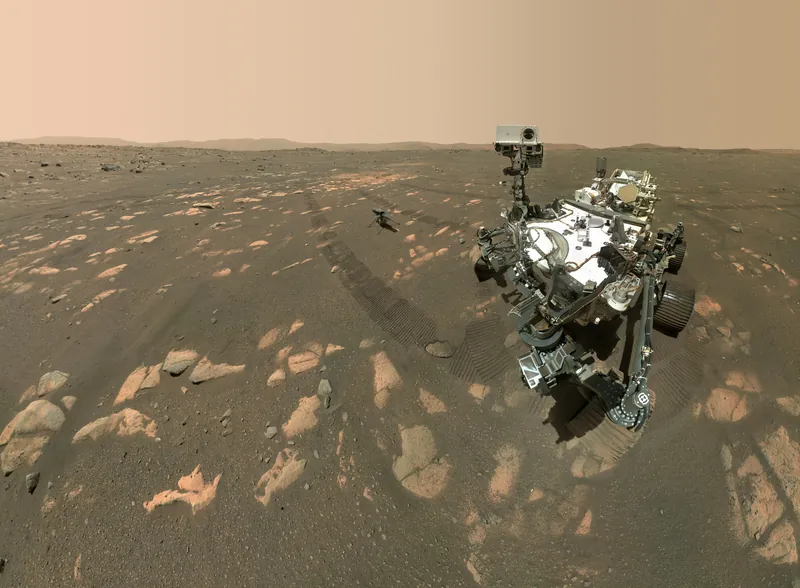
Mars is one of the most explored worlds in the Solar System. It is a cold desert about half the width of Earth, with the largest known volcano in the Solar System, a canyon system more than 3,000 km long and two tiny, lumpy moons.
Here is the real journey first, with the numbers from NASA, then how the LIFTONAUT Mars tour turns it into a short simulated flight without bending the facts.
How far is Mars, and how long does the real trip take?
The distance changes all the time, because Earth and Mars circle the Sun at different speeds. At their closest the two planets are about 54.6 million km apart (34 million miles); at their farthest, on opposite sides of the Sun, about 401 million km (249 million miles). On average Mars orbits 228 million km from the Sun, 1.5 times farther out than Earth, and sunlight takes about 13 minutes to get there.
- distance from Earth, closest to farthest
- 54.6–401 million km
- a typical trip with today's rockets
- 7–10 months
- between launch opportunities
- about 26 months
Why real trips take months
Spacecraft do not fly straight at Mars. They are launched into an orbit around the Sun that meets the planet months later, which saves an enormous amount of fuel. NASA puts a typical direct trip at seven to ten months. Perseverance, for example, launched on July 30, 2020 and landed on February 18, 2021.
The planets have to be in the right places when you leave, so launch windows are rare: Earth laps Mars about once every 26 months. Radio messages are slow too: depending on the distance, a signal needs roughly 3 to 22 minutes to cross between the planets, so rovers cannot be steered live from Earth: they follow commands sent in advance.
The route: a Moon flyby, then the Red Planet
Your flight starts like every LIFTONAUT tour: the GO/NO-GO poll, the countdown, liftoff, Max-Q, stage separation and orbit, with the first minutes of the climb in real time. Then the ship leaves orbit and passes the Moon before the long cruise to Mars.
Time is compressed, distances are not. The planets sit where they really are on the day of your flight, computed from NASA/JPL orbital elements, and the guide tells you how long the same leg would have taken in real time.

Mars's thin air and its color
As you arrive, the planet fills the window: rust-colored plains, dark volcanic areas and white polar caps. Mars is red because iron minerals in its dust have rusted. Its air is thin, about 95% carbon dioxide, with a surface pressure less than 1% of Earth's, so it cannot hold much heat: the average is around −60 °C.
Phobos and Deimos: the two small moons of Mars
Mars has two moons, both discovered by the astronomer Asaph Hall in August 1877. Their names mean fear (Phobos) and dread (Deimos). They are small, dark and lumpy, and the tour flies past both.
- Phobos measures about 27 × 22 × 18 km and orbits only about 6,000 km above the surface, closer than any other known moon to its planet. It circles Mars three times a day and is creeping inward by about 1.8 meters every hundred years. In roughly 50 million years it will crash into Mars or break up into a ring.
- Deimos is even smaller, about 15 × 12 × 11 km, and takes 30 hours to go around once. Partly filled craters make its surface look smoother than Phobos.
Key numbers · Mars
- Diameter
- 6,779 km
- Surface gravity
- 3.73 m/s² · 38% of Earth’s
- Length of day
- 24 h 40 min
- Length of year
- 687 days
- Known moons
- 2
- Mean temperature
- −59 °C (−153 °C … 20 °C)
- Mean distance from the Sun
- 1.52 AU
Olympus Mons and the rover sites
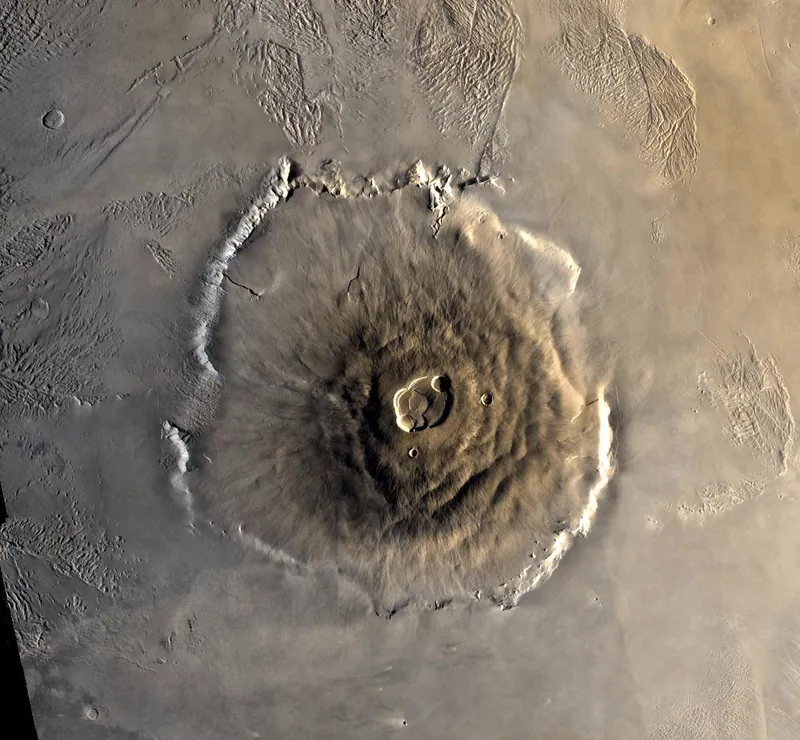
During the flyby, discreet markers show three places on the surface, at their real coordinates. The first is Olympus Mons, the largest known volcano in the Solar System: about 600 km across, with its summit caldera roughly 24 km above the surrounding plains, nearly three times the height of Mount Everest.
Where the rovers landed
The other two markers are rover landing sites. Curiosity touched down in Gale Crater on August 6, 2012. Perseverance landed in Jezero Crater, an ancient lake bed, on February 18, 2021, carrying the Ingenuity helicopter, and has been collecting rock samples for future study.
The first close-up pictures of Mars came from Mariner 4, which flew past in July 1965. The photos you see during the tour are real NASA images, credited on screen.
Tour details: about 12 minutes, €2.99, 10 seats
The Mars tour lasts about 12 minutes, from the GO/NO-GO poll to touchdown on the same pad, and a seat costs €2.99. Each rocket carries ten passengers, every seat faces the five windows, and departures leave every ten minutes.
- Seven cameras, from the cabin and the window to a chase camera and the map, with an automatic director that cuts like a live broadcast.
- Mission Control voices and a guide, voiced in English and Romanian, with on-screen text in five languages.
- Real NASA and ESA photos with their credits, and a source for every number.
For a longer flight, the Giants continue to Jupiter and Saturn and the Grand Tour visits every planet. The free trial flight covers liftoff, staging and the trip to the Moon.
Mars questions
How long does it take to travel to Mars?
With today's rockets, about seven to ten months on a fairly direct route. Perseverance launched on July 30, 2020 and landed on February 18, 2021. In LIFTONAUT the trip is compressed into a flight of about 12 minutes.
How far away is Mars?
It depends on where the two planets are in their orbits: about 54.6 million km at the closest and about 401 million km at the farthest. On average, Mars orbits 228 million km from the Sun, 1.5 times farther than Earth.
Can humans travel to Mars today?
Not yet. Every mission to Mars so far has been robotic: orbiters, landers and rovers. A crewed trip would take many months each way and would need protection from radiation, enough supplies and a way to launch back off the surface, which space agencies are still working on.
What can you see on Mars?
Olympus Mons, the largest known volcano in the Solar System; Valles Marineris, a canyon system nearly 3,900 km long and up to about 9 km deep; polar ice caps; craters; and the two small moons. The tour flies past both moons and marks Olympus Mons and two rover landing sites.
Is there a Mars travel simulator online?
Yes. LIFTONAUT runs in your browser: you take one of ten seats in the cabin, launch from Earth, pass the Moon and reach Mars, with the planets in their real positions for the day you fly. The Mars tour costs €2.99, and a free trial flight covers liftoff, staging and the trip to the Moon.
Sources
The numbers on this page come from these official sources.
- NASA Science · Mars facts
- NASA NSSDCA · Mars Fact Sheet (distances from Earth, atmosphere)
- NASA · How long does it take to get to the Moon, Mars, Jupiter? (We Asked a NASA Expert)
- NASA/JPL · Mars 2020 launch press kit (the 26-month cycle)
- NASA Science · Mars 2020 Perseverance mission
- NASA Science · Phobos
- NASA Science · Deimos
- NASA/JPL · Olympus Mons (Viking 1 mosaic)
- NASA Science · Mariner 4