
Destination · The giant planets
Trip to Saturn and Jupiter: The Giants Tour, With Rings and Moons
Real spacecraft need years to reach the outer planets. The LIFTONAUT Giants tour crosses the asteroid belt and flies past Jupiter, Saturn and its rings, Uranus and Neptune, with their moons, in about 17 minutes, with each planet where it really is on the day you fly.

Beyond the asteroid belt orbit the four largest planets: Jupiter and Saturn, the gas giants, and Uranus and Neptune, the ice giants. Between them they have hundreds of known moons, from volcanic Io to Titan with its methane lakes.
Here is how far they are, how long the real trips took, and what you will see on the tour.
The giants of the Solar System, in one flight
Jupiter is more than half a billion kilometers from Earth, and light needs over half an hour to get there; Saturn is always more than 1.2 billion km away, over an hour for light. Neptune is so far that sunlight takes about four hours to reach it.
| Mission | Destination | Time to arrive |
|---|---|---|
| Voyager 1 (flyby) | Jupiter | 18 months (1977–1979) |
| Juno (orbiter) | Jupiter | just under 5 years (2011–2016) |
| Voyager 1 (flyby) | Saturn | just over 3 years (1977–1980) |
| Cassini (orbiter) | Saturn | almost 7 years (1997–2004) |
| Voyager 2 (flyby) | Uranus · Neptune | 8.5 years · 12 years |
The tour compresses those years into minutes; distances and positions stay real, and the guide tells you how long each leg would have taken.
Crossing the asteroid belt (it is emptier than you think)
Between Mars and Jupiter lies the main asteroid belt, estimated to hold more than a million asteroids larger than 1 km. In the movies it is a crowded field of tumbling rocks. In reality, neighboring asteroids are on average more than three times the Earth–Moon distance apart, and all of them together have less mass than our Moon.
That is why probes cross it without trouble: Pioneer 10 was the first, in 1972 and 1973. The simulation keeps the real density, so the window shows only a few faint points drifting against the stars. It also places one large asteroid near the route on purpose, so you can see what one looks like up close; a real crossing would rarely come that near.
Jupiter: the largest planet and its moons
Jupiter could hold more than 1,300 Earths. Its stripes are clouds of ammonia and water carried by opposing winds, and the Great Red Spot is a storm bigger than Earth that has raged for hundreds of years. A day lasts less than ten hours, the shortest of any planet.
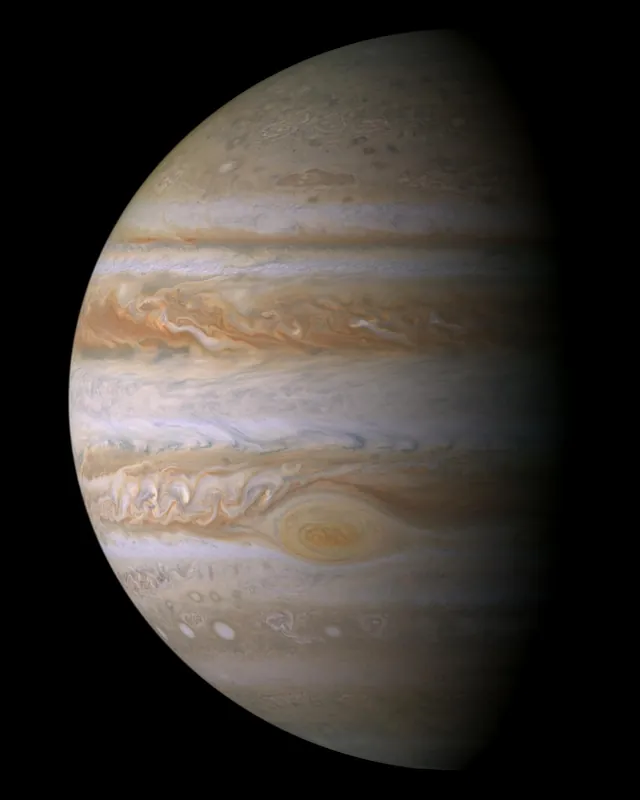
NASA counts 115 moons. Galileo Galilei discovered the four largest in 1610: Io, the most volcanically active world in the Solar System; Europa, which likely hides a salty ocean under its ice; Ganymede, the largest moon of all, bigger than the planet Mercury; and Callisto, the most heavily cratered object known.
Saturn: the rings up close
Saturn is the star of the tour. Its ring system extends up to 282,000 km from the planet, and the planet itself is less dense than water: on average just 687 kg per cubic meter.
What the rings are made of
Billions of chunks of ice and rock, from grains of dust to blocks the size of a house, each on its own orbit around the planet.
How thin the rings really are
For all their width, the main rings are typically only about 10 meters thick. Seen edge-on, they almost vanish.
Titan and Enceladus
Saturn has 293 confirmed moons, more than any other planet. Titan, larger than Mercury, is the only moon with a thick atmosphere, and it has rain, rivers and seas of liquid methane and ethane. Little Enceladus sprays jets of water vapor and ice into space from an ocean hidden under its crust.
Key numbers · Saturn
- Diameter
- 116,464 km
- Gravity at 1 bar
- 11.19 m/s² · 114% of Earth’s
- Length of day
- 10 h 39 min
- Length of year
- 29.4 years
- Known moons
- 293
- Temperature at 1 bar
- −139 °C
- Mean distance from the Sun
- 9.57 AU
Uranus and Neptune, the ice giants
Uranus spins on its side, tilted by almost 98°, so each pole gets decades of daylight and then decades of night; its blue-green color comes from methane, which absorbs red light. Neptune has the fastest winds measured on any planet, up to 580 m/s, over 2,000 km/h. Its largest moon, Triton, orbits backwards and has geysers; Voyager 2 measured −235 °C on its surface.
Only one spacecraft has visited either planet: Voyager 2, at Uranus in 1986 and at Neptune in 1989.
Tour details: about 17 minutes, €3.99
The Giants tour lasts about 17 minutes, from the GO/NO-GO poll to touchdown on the same pad, and costs €3.99 per seat, with ten seats per rocket and a departure every ten minutes. To add the Moon, the inner planets and Pluto, take the Grand Tour; to go further still, see the Complete Solar System.
Giant planet questions
How long does it take to get to Saturn?
Years. Voyager 1 flew past Saturn just over three years after launch, while the Cassini orbiter took almost seven years to arrive, in 2004. The LIFTONAUT Giants tour reaches Saturn within a flight of about 17 minutes.
How long does it take to get to Jupiter?
Orbiters take about five to six years: Galileo a little over six, Juno just under five. Fast flybys are quicker: Voyager 1 reached Jupiter about 18 months after launch.
What are Saturn's rings made of?
Chunks of ice and rock, from dust grains to blocks the size of a house. The ring system reaches 282,000 km from the planet, yet the main rings are typically only about 10 meters thick.
How many moons do Saturn and Jupiter have?
NASA counts 293 confirmed moons for Saturn and 115 for Jupiter. The numbers keep changing as astronomers confirm new small moons.
Can you see Saturn's rings up close in a simulator?
Yes. On the LIFTONAUT Giants tour and the Grand Tour the ship flies past Saturn and its rings, lit by the Sun from its real direction for the day you fly.
Sources
The numbers on this page come from these official sources.
- NASA Science · Saturn facts
- NASA Science · Jupiter facts
- NASA Space Place · How many moons? (current counts)
- NASA · How long does it take to get to the Moon, Mars, Jupiter? (We Asked a NASA Expert)
- NASA Science · Voyager 1
- NASA Science · Voyager 2
- NASA Science · Cassini
- NASA Science · Asteroid facts
- NASA/JPL Night Sky Network · The scale of the asteroid belt
- NASA NSSDCA · Neptune Fact Sheet (winds)